
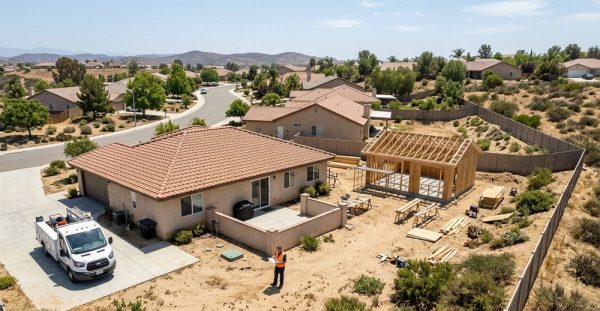
 If you are adding an accessory dwelling unit to your property in San Diego, your septic system is not an afterthought — it is a gating requirement. An ADU septic system in San Diego must demonstrate that it can handle the additional daily wastewater load before San Diego County will issue your building permits. Skip this step and your project stalls mid-application. Dr. Septic San Diego works with homeowners across East County, North County Inland, Poway, Escondido, and beyond to evaluate, certify, and upgrade systems ahead of ADU projects.
Here is exactly what the county checks, when you will need an upgrade, and how to keep your project on schedule.
Why Your Septic System Is Part of the ADU Permit Process
Your septic tank was sized when your home was originally built, based on the number of bedrooms at the time. California uses a daily wastewater flow estimate of roughly 150 gallons per bedroom per day to determine minimum tank capacity. Add a one-bedroom ADU, and you are adding approximately 150 gallons of daily load to a system that may already be operating near its design limit.
The drain field carries equal weight in this calculation. An aging leach field that is already absorbing near-maximum flow will fail faster when demand increases — and drain field failures are expensive to fix, far more than a pre-build evaluation costs. The San Diego County Department of Environmental Health (DEH) reviews septic capacity as part of the ADU permitting process precisely because this failure pattern is predictable.
San Diego ADU Septic Requirements: What the DEH Evaluates
The DEH governs on-site wastewater treatment systems (OWTS) in unincorporated San Diego County under Title 7 of the County Code of Regulatory Ordinances. When you submit an ADU application, the DEH will require documentation confirming that your existing system can absorb the added wastewater load. San Diego ADU septic requirements specifically look at your tank’s total gallon capacity, the size and condition of your drain field, and the soil percolation rate on your property.
If your system records are incomplete or your tank has not been serviced recently, the DEH will require a certified inspection before moving your application forward. One additional item that catches homeowners off guard: properties in unincorporated San Diego County are required to hold an annual operating permit for their septic system. If yours has lapsed, that must be resolved before any building department will process your ADU application.
An important note for homeowners in incorporated cities — El Cajon, Escondido, Santee, and others — the process runs through those municipalities rather than the county DEH directly, but the capacity verification requirement is the same. Call Dr. Septic first to confirm the right path for your specific address.
The Pre-ADU Septic Inspection: What It Covers
A pre-ADU septic inspection from Dr. Septic San Diego is not the same as a routine pump-out. It is a documented capacity evaluation. Jerry and the team locate all access points, measure current sludge and scum levels, inspect the inlet and outlet baffles, confirm tank volume, and assess the drain field for signs of saturation or root intrusion. You receive a written report formatted for DEH submission and usable directly by your ADU contractor or architect.
Schedule this inspection before you finalize your ADU design. If an upgrade is required, you need to know that before paying for architectural drawings sized to a lot where the drain field footprint may need to expand. Getting the inspection early is the single best thing you can do to keep your project timeline intact.
Schedule your ADU septic evaluation with Dr. Septic San Diego →
When You Need an Upgrade — and When You Do Not
Not every homeowner faces a full system replacement. Septic capacity ADU evaluations frequently find that a tank upsizing alone — moving from a 1,000-gallon tank to a 1,500-gallon tank, for example — is sufficient to meet the added demand. In other cases, drain field expansion is required, which adds infiltration area to the existing leach field or converts the system to an alternative treatment design approved by the DEH.
According to the California State Water Resources Control Board, alternative OWTS designs — including aerobic treatment units and mound systems — are increasingly approved in San Diego County for properties where conventional drain field expansion is not feasible due to lot constraints, soil conditions, or proximity to groundwater. These systems cost more upfront but are a fully compliant path when standard expansion is not an option. Many homeowners are surprised to learn their existing system already qualifies with minor modifications — a capacity evaluation gives you that answer before you assume the worst.
What ADU Septic Upgrades Cost in San Diego
Costs vary based on what the evaluation actually finds. A tank replacement or upsizing in San Diego County typically runs between $3,500 and $7,000, including labor, permits, and the follow-up inspection. Drain field expansion adds to that figure — $5,000 to $15,000 depending on the linear footage required and your property’s soil conditions.
Alternative OWTS installations generally run $15,000 to $30,000 or higher. That range sounds steep in isolation, but an ADU generating $1,800 to $3,500 per month in San Diego’s rental market — which is realistic for a one-bedroom unit in most of our service areas — pays back that investment quickly. Get the evaluation first. The cost to upgrade is always clearer than the cost to delay a permitted ADU project by three to six months.
Three Mistakes That Delay ADU Permits in San Diego
First: pumping the tank immediately before the inspection. Sludge and scum levels are part of how inspectors measure system health and capacity usage. An empty tank gives an incomplete picture and can actually slow the evaluation process.
Second: assuming your system records are on file with the county. Many properties in East County and North County Inland have ownership histories that predate digital record-keeping. Request your septic system records from the San Diego County DEH before your inspection appointment so your contractor has a full history to work from.
Third: treating the septic evaluation as the last item to check off before construction. It should be among the first. If an upgrade is needed, the DEH permitting and construction timeline typically runs four to twelve weeks. Starting the evaluation after everything else is finalized is how homeowners end up extending their project timeline by an entire quarter.
Frequently Asked Questions
Does every ADU in San Diego require a septic evaluation?
If your property is served by a private septic system rather than public sewer, yes. San Diego County requires capacity verification as part of the ADU permitting process for all properties on on-site wastewater systems. Properties connected to municipal sewer go through a separate process with the local water authority.
How long does the septic evaluation process take?
The on-site inspection typically takes one to two hours. The written report is usually ready within 48 hours. If an upgrade is needed, the DEH permitting and construction process generally runs four to twelve weeks depending on scope and current county processing times. This is why starting early matters.
Can I add a junior ADU (JADU) without a septic upgrade?
Possibly. A JADU within the existing footprint of your home may have a smaller capacity impact than a detached ADU. However, the DEH still reviews your system as part of the process. Whether you qualify without an upgrade depends on your current tank size, household size, and drain field condition. There is no blanket exemption — get the evaluation first.
What happens if my system fails the ADU capacity evaluation?
Your building permit will not advance until the system is upgraded or you qualify through an alternative compliance path approved by the DEH. This is not a dead end — it is a step in the process. Dr. Septic San Diego will walk you through your options and connect you with licensed contractors for any required work.
Work With a Licensed Septic Contractor Who Knows the DEH Process
The accessory dwelling unit septic San Diego permitting process moves faster when you start with a contractor who already knows what the county needs. Dr. Septic San Diego is licensed, certified, and experienced with DEH capacity evaluations across all 13 communities we serve — from Poway and Encinitas to El Cajon and La Mesa.
Jerry and the team provide written reports that meet DEH submission requirements and hold up through the full permitting process. We schedule ADU evaluations seven days a week, including same-day appointments when your project timeline is tight. Call before your permit application — not after it gets held up.
Ready to Get Started?
A pre-ADU septic evaluation is the first move toward getting your project permitted on time. Dr. Septic San Diego provides certified inspections and DEH-ready written reports for homeowners across San Diego County.
Schedule Your ADU Septic Evaluation or call us at (619) 417-9097.